Introduction
News

|
Inspired by the panther chameleon's sophisticated color-adaptive abilities, we introduce a unified design framework for a new class of bio-inspired mechanochromic materials with tailored reflectivity across the electromagnetic spectrum. While structural coloration in nature relies on the mechanical adjustment of photonic crystal spacing, engineering such systems is often hindered by the barreling effect, the lateral bulging of bulk materials caused by Poisson's effect. To address this, we developed a mechanical metamaterial substrate optimized through a genetic algorithm and modeled it using Timoshenko beam theory to ensure a uniform strain field during deformation. The proposed system features a two-dimensional hexagonal lattice of composite dielectric nanopillars on a micro-architected substrate fabricated via Multiphoton Lithography (MPL). Stefanos Mavrikos, a LTL PhD candidate, led this work along with Nikolina Nikolarea, a graduate of the National Technical University of Athens (NTUA), Greece.
This work was published in Materials Horizons, https://pubs.rsc.org/mh/article/13/16/8002/1266968/Bio-inspired-micro-architected-mechanochromic |

|
Multifunctional materials that balance mechanical resilience and fluid dynamic efficiency are critical in engineering applications, yet their synergistic optimization remains challenging due to inherent trade-offs, computational expense, and high-dimensional design spaces. Inspired by the skeleton of the deep-sea sponge Euplectella aspergillum, this work presents an automated framework integrating Finite Element Analysis for mechanics, Computational Fluid Dynamics for flow behavior, and multi-objective Bayesian optimization. By jointly optimizing mechanics and fluidics, this work establishes a scalable methodology for designing lightweight, high-performance architected materials. Timon Meier, a recent LTL PhD graduate led the work along with Sergey Livitnov of Prof. Petros Koumoutsakos’ Harvard University group. Professor Simo Mäkiharju of UCB ME and Xiaoyu Zheng of UCB MSE collaborated on this work along with Prof. M. Erden Yildizdag of Istanbul Technical University. Runxuan Li, Brian Blankenship, Stefanos Mavrikos, Andrew Kokubun, David Hahn and Zacharias Vangelatos contributed to the research.
This work was published in Nature Communications, https://www.nature.com/articles/s41467-026-72612-4 |

Recent advances in bandgap engineering of low-dimensional semiconductors have enabled high-efficiency carrier transport in miniaturized electronic and optoelectronic devices. The physical properties and functionalities of these materials are governed by complex carrier dynamics coupled with multiple transport mechanisms in tailored band structures. LTL PhD graduate Rundi Yang reported on ultrafast nanoimaging of carrier funneling and recombination in composition-grade CdSxSe1-x nanowires using pump–probe near-field nanoscopy. The findings provided direct visualization of nanoscale carrier transport while putting forward an effective approach for investigating complex carrier interactions in inhomogeneous semiconductor nanostructures, with implications for optimizing next-generation optoelectronic devices. Runxuan (Jacky) Li, a current LTL student also contributed to the work in collaboration with Prof.Junqiao Wu of UCB MSE and Prof. Pengfei Guo’s group of Taiyuan University of Technology. Prof Jingang Li of Purdue University, carried out the research with the Berkeley team during his post-doc stay at LTL.
This work was published in ACS Nano,
https://pubs.acs.org/doi/10.1021/acsnano.5c18505
This work was published in ACS Nano,
https://pubs.acs.org/doi/10.1021/acsnano.5c18505

|
We are excited to share that our lab’s research was featured by Ansys! The Ansys case study showcases how we used PyAnsys and Python to automate the design and optimization of mechanical metamaterials. Led by PhD candidates Timon Meier and Runxuan Li, the work developed a fully automated workflow that explored vast design spaces and designed metamaterials that are simultaneously auxetic and isotropic, two rarely coexisting properties. Published in npj Computational Materials, our research highlights how high-throughput FEA simulations and optimization can accelerate the discovery and tailored design of architected materials.
Access the full Ansys write up here |

|
Thermovoltaic and solar thermal systems require emitters with high emissivity and durability at high temperatures. A femtosecond laser was used to machine light-trapping hierarchical micro/nanostuctures on metal surfaces, thereby achieving near blackbody emissivity over a wide spectral range while remaining stable at high temperatures. The fabricated emitted demonstrated doubling of therm-voltaic power without compromising efficiency. Minok Park, currently at Kongju National University in Korea is the first author of this study. The work was a collaboration of Vassilia Zorba's LBNL team with Asegun Henry of MIT, and Sean Lubner of Boston University. This work was published in Joule,
https://doi.org/10.1016/j.joule.2025.102005 |
|
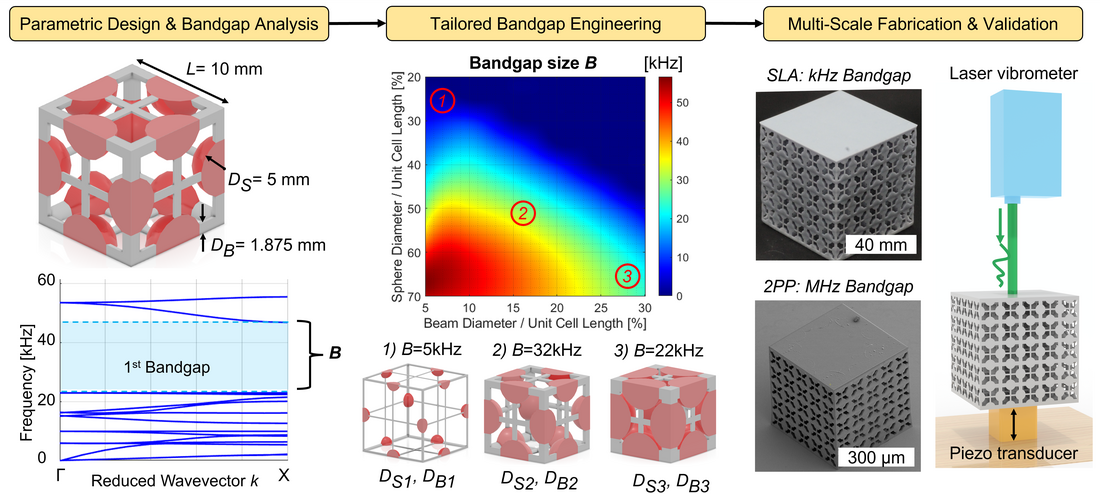
PhD candidates Timon Meier and Vasileios Korakis present a scalable design framework for phononic metamaterials with ultra-wide, tunable bandgaps, achieving up to 172% normalized bandgap width. Inspired by the Yablonovite structure, their work leverages FEA simulations to create a parametric design space that links geometry to phononic behavior. The framework enables precise bandgap tailoring across scales, with designs fabricated at macro (10 mm) and micro (80 µm) levels using SLA and Two-Photon Polymerization. Experimental transmission loss measurements, closely match simulation predictions, validating the framework across multiple length scales. This study bridges theory and experiment, offering a practical and efficient path to custom-designed phononic metamaterials for vibration isolation, waveguiding, and ultrasonic applications. This work was published in Materials & Design: doi.org/10.1016/j.matdes.2025.113778
|

|
Laser-assisted atomic layer etching (ALEt) is a key technology enabling the minituarization of semiconductor devices. However, the mechanisms behind the laser−gas interactions and subsequent surface modifications remain elusive. PhD candidate Runxuan Li demonstrated ultraviolet picosecond laser-induced atomic layer etching of silicon in a gaseous chlorine environment, achieving selflimited etching with a precision of 0.93 nm/cycle. Through in situ optical emission spectroscopy, he elucidated the transition energy states of laser-excited products during chlorination. Simulation of transient adsorption of chlorine atoms reveals the complex spatiotemporal dynamics and surface saturation of laser-assisted ALEt processes. This work was published in The Journal of Physical Chemistry C, doi.org/10.1021/acs.jpcc.4c07330
|
About
|
The Laser Thermal Lab is directed by Prof. Costas P Grigoropoulos of the Mechanical Engineering Department, UC Berkeley. Current research interests are focused on laser materials interactions, nanomanufacturing and the fundamental study of microscale and nanoscale transport phenomena.
Learn more about LTL |
Some Recent Publications
|
For a full list go to the Publications/Journals
|
|

|

|